


Our son returned home from a year of Bible College with a head full of knowledge, a heart full of inspiration and a box full of course outlines, booklets, notes, handouts and photocopies of articles and book chapters. Among these were two chapters from Madeleine L’Engle’s 1980 book Walking on Water: Reflections on Faith and Art.
While the famous author of “A Wrinkle in Time” and many other books and stories died in 2007, a very rich and lively website is being maintained in her name, featuring not only her books but even events based on many of the titles continuing to this day.
Here is just one screen capture from https://www.madeleinelengle.com/madeleine-lengle/.
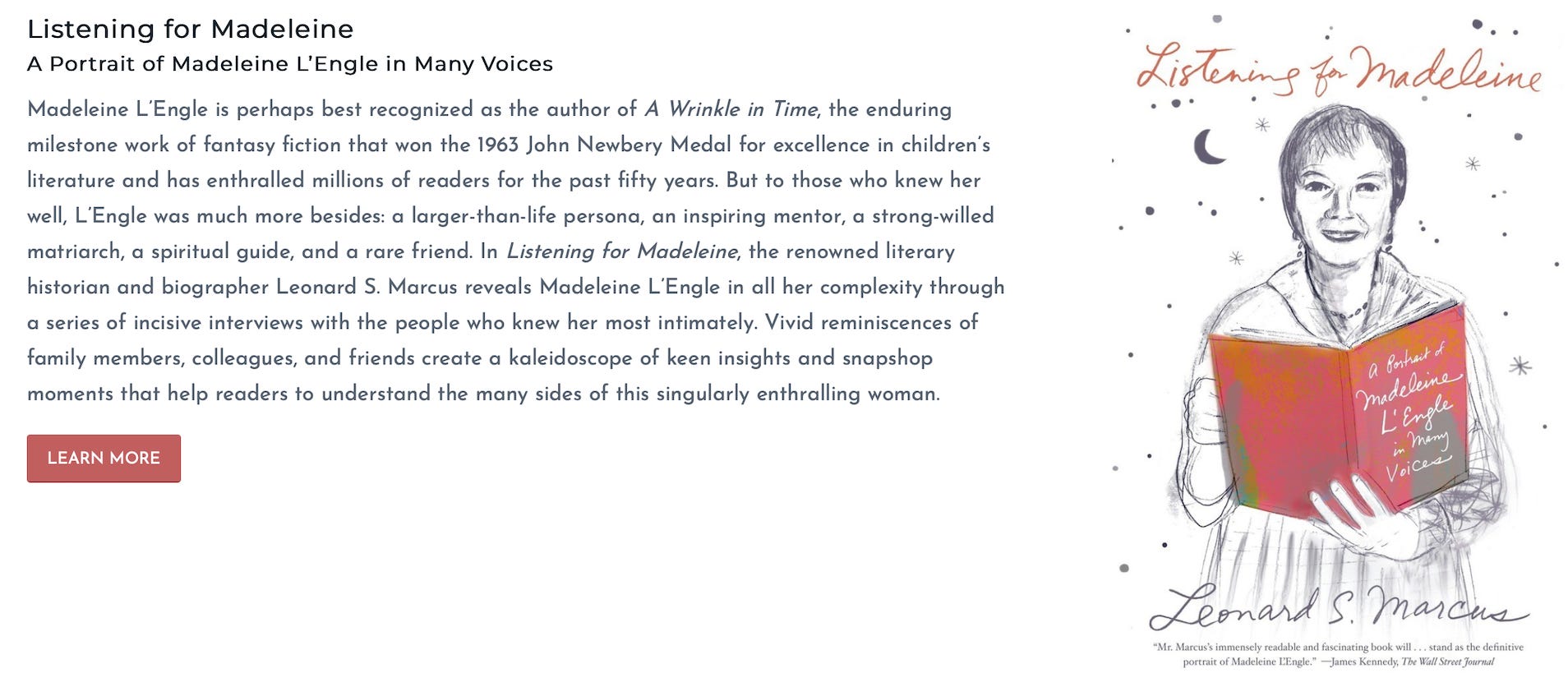
In reading through the two chapters my son brought home, I found a lot of food for thought. (No wonder one of the instructors selected them as part of their course materials!)
Listening to the Silence
When I am constantly running down there is no time for being.
When there is no time for being there is no time for listening.
I will never understand the silent dying of the green pie-apple tree if I do not slow down and listen to what the Spirit is telling me, telling me of the death of trees, the death of planets, of people, and what these deaths mean in the light of love of the Creator who brought them all into being; who brought me into being; and you…
And as I listen to the silence, I learn that my feelings about art and my feelings about the Creator of the universe are inseparable. To try to talk about art and about Christianity is for me one and the same thing, and it means attempting to share the meaning of my life, what gives it, for me, its tragedy and its glory. It is what makes me respond to the death of an apple tree, the birth of a puppy, northern lights shaking the sky, by writing stories. (back cover)
God Appears in the Clouds
LIGHT—DARK; BRILLIANCE—CLOUD. How often God appears in a cloud. A cloud was the sign of God’s presence as he led Moses and the children of Israel towards the Promised Land, and the cloud by day became a pillar of fire by night. The psalmist sings out the great affirmation, “Yes, the darkness is no darkness with you, O Lord, the night is as close as the day; the darkness and light to you are both alike.”
L’Engle reminds readers of various other instances in which an extraordinary cloud signalled God With Us and when in response people’s faces shone with extraordinary brilliance: Moses; Ezekiel “with his great wheels of light”; Adam and Eve “cowered before it when the cherubim held swords of flame to bar them from their garden home”; when the ark of the covenant was carried into the Holy of Holies once the building of Solomon’s temple was completed.
When the priests came out of the sanctuary, the cloud filled the temple of the Lord, and the priests could not bear to minister because of the cloud, for the glory of the Creator of the Galaxies had filled the house of the Lord.
When did we last see that light in the sanctuary of one of our churches, no matter what denomination or affiliation? Perhaps it is there, but we may not recognize it because we are afraid of it. We have become so bound by the restrictions of the choices made by others over the past centuries that we cannot see it. We are afraid of that which we cannot control; so we continue to draw in the boundaries around us, to limit ourselves to what we can know and understand. Thus we lose our human calling, because we do not dare to be creators, co-creators with God.
Artists have always been drawn to the wild, wide elements they cannot control or understand—the sea, mountains, fire. To be an artist means to approach the light, and that means to let go our control, to allow our whole selves to be placed with absolute faith in that which is greater than we are. The novel we sit down to write, and the one we end up writing may be very different, just as the Jesus we grasp and the Jesus who grasps us may also differ. (Chapter 10)
Love, Play and Work
L’Engle was married to actor Hugh Franklin.
One of the librarians asked me, “What do you think you and Hugh have done which was best for your children?” I answered immediately and without thinking, “We love each other.” (Chapter 10)
Also in that chapter, in an exposition of WORK vs. PLAY, she writes:
Hugh and I are among the world’s lucky ones, reminding ourselves frequently how fortunate we both are to be doing work which we love, work which is, for us, play.
Prayer and Listening
On prayer and listening, L’Engle writes:
No matter where I am, at home, abroad, I begin the day with morning prayer, including the psalms for the day, so that at the end of each month I have gone through the book of Psalms. I also read from both the Old and the New Testaments. And there is almost always something in the Psalms or the other Scriptures which I need to hear for that day, something I may have read hundreds of times before, but which suddenly springs out at me with new meaning.
I end the day, in the same way, with evening prayer, and this gives the day a structure. Between these two joyful disciplines, the day is also moderately structured. I write all morning. Lunch is often shared with a friend. Then, most afternoons I return to my manuscript…
Or, she might go to the library, or take her garden clippers to clip back a particular weed that overgrows the trees near a brook…
Sitting, or better, lying on one of my favourite sun-warmed rocks, I try to take the time to let go, to listen, in much the same way as I listen when I am writing. This is praying time, and the act of listening in prayer is the same act as listening in writing. And again, comparisons need not come into it, the prayer of the saint is not necessarily “better” than the prayer of the peasant.
And then there is time in which to be, simply to be, that time in which God quietly tells us who we are and who he wants us to be. It is then that God can take our emptiness and fill it up with what he wants, and drain away the business with which we inevitably get involved in the dailiness of human living.
On Control, Virtue, Faith & Coming Home
We live under the illusion that if we can acquire complete control, we can understand God…But the only way we can brush against the hem of the Lord, or hope to be part of the creative process, is to have the courage, the faith, to abandon control.
For the opposite of sin is faith, and never virtue, and we live in a world which believes that self-control can make us virtuous. But that’s not now it works. How many men and women we have encountered, of great personal virtue and moral rectitude, convinced of their own righteousness, who have also been totally insensitive to the needs of others, and sometimes downright cruel!! …
When I urge that we abandon rigid self-control I am not suggesting that we abandon ourselves into hysteria or licentiousness, uninhibited temper tantrums or self-indulgence. Anything but. However, when we try to control our lives totally with the self that we think we know, “the result is that growth in self-awareness is inhibited.”
Here L’Engle cites Church of England monk H.A. Williams who continues,
“there is a sort of devilish perversity in this organizing me not to sin by means of the very thing which ensures that I shall. Faith, on the other hand, consists in the awareness that I am more than I know.” Such awareness comes to the prodigal son when he realized that he was more than a starving swineherd. What led him home was his becoming aware that he was also his father’s son. Yet his awareness of sonship was enough to make him journey homewards.
The journey homeward. Coming home. That’s what it is all about. The journey to the coming of the Kingdom. That’s probably the chief difference between the Christian and the secular artist—the purpose of the work, be it story or music or painting, is to further the coming of the kingdom, to make us aware of our status as children of God, and to turn our feet toward home.
On Prayer as Collaboration between the Mind and the Heart
In prayer, in the creative process, these two parts of ourselves, the mind and the heart, the intellect and the intuition, the conscious and the subconscious mind, stop fighting each other and collaborate. Theophan the Recluse advised those who came to him for counsel to “pray with the mind in the heart,” and surely this is how the artist works. When mind and heart work together, they know each other as two people who love each other know; and as the love of two people is a gift, a totally unmerited, incomprehensible gift, so is the union of mind and heart. David cried out to God, “Unite my heart to fear thy Name.” It is my prayer, too.
On Artists’ Techniques, Discipline & Inspiration
Most artists are aware that during the deepest moments of that creation they are out on the other side of themselves, and so are free from time, with the same joyousness that comes in the greatest moments of prayer… The paradox is that the creative process is incomplete unless the artist is, in the best and most proper sense of the word, a technician, one who knows the tools of his trade, has studied his techniques, is disciplined…
The moment of inspiration does not come to someone who lolls around expecting the gift to be free. It is no give-away. It is the pearl for which we have to pay a great price, the price of intense loneliness, the price of that vulnerability which allows us to be hurt; the less readily understandable price of hurting those we love, …And I am not sure if it’s a choice. If we’re given a gift—and the size of the gift, great or small, is irrelevant—then most of us must serve it, like it or not. I say most of us, because I have seen people of great talent who have done nothing with it, and who mutter about getting down to work “when there’s time.”
On Serving the Gifts one has been given
It is a joy to be allowed to be a servant of the work. And it is a humbling and exciting thing to know that my work knows more than I do.
In Chapter 11 of her book Madeleine L’Engle takes readers behind the scenes, admitting how little she knew of Newtonian physics as she was writing A Wrinkle in Time, but rather, she was gifted with encounters with others who provided the needed expertise just at the right time. Similar encounters shaped her work in many other instances, both in her fiction and non-fiction writing. Often her habits of listening alert her when something is not working behind some aspect of a plot. Then someone, somewhere, shares information with her that she can use to rectify the problem. Of one example she remarks,
How to explain this? I can’t. But it strikes me as more than that I was unknowingly dipping into the collective unconscious. My guardian angel was certainly working overtime, and I accepted the miracle with awe and gratitude. …
What made [certain people] insist on [a certain topic] just as I was ending my book? Perhaps the only part I had in it was accepting the discipline of listening, or training the ability to recognize something when it is offered. …just what I needed, given me in a great unexpected gift at exactly the moment I needed it.
I don’t pretend to understand any of this in the language of provable fact, but that is the language of works, the language of man’s control, not the language of faith.
I only know that these gifts are given, and that I believe in them.
H. A. Williams continues, “Justification by faith means that I have nothing else on which to depend except my receptivity to that what I can never own or manage. And this very capacity to receive cannot be the result of effort. Faith is something given, not achieved. It is created by God’s word in Christ.”
For the Christian writer, that’s what the creative process is all about.
“Faith is not reasonable, it is marvellous.” Madeleine L’Engle
Moved by her WRINKLE IN TIME, I was fortunate to hear her speak at Indiana University in 1970 and was amazed and inspired by her creativity and character. Thank you for posting this.